- Estate Planning
- Interesting
What Do Australians Leave in Their Will? (2026 Data)
In a year of Wills made with Will Hero, most people didn't leave a single specific gift — they simply divided the whole estate. And when they did name a gift, it was more often than not a physical object, rather than money. Here's what the data shows.
The big picture
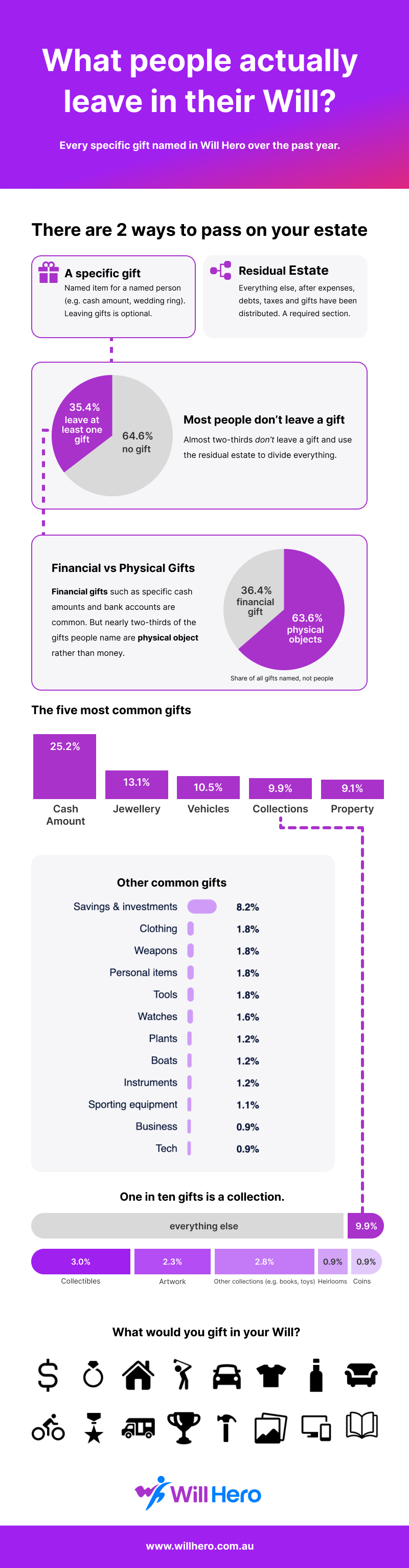
In a year of Wills made with Will Hero, most people didn’t leave a single specific gift — around 64.6% simply divided their whole estate between the people they chose. When people did name a gift, it was more often than not a physical object rather than money (63.6% of gifts are physical), and the single most common gift of all was a cash amount (25.2%). Here’s the full breakdown of what our customers chose.
When you make a Will you generally do two things: you say who shares in your estate as a whole, and — optionally — you leave one or more specific gifts first (a set sum of money, or a particular item like a ring or a car). Over the past year we looked at what Will Hero customers actually chose, to answer a simple question: when people sit down to write their Will, what do they leave behind?
About this data. Figures are based on specific gifts recorded by Will Hero customers over the past 12 months, and reflect our own customers rather than a representative sample of all Australians. All numbers are aggregated and de-identified — they describe the group as a whole and cannot be traced to any individual. Percentages are rounded and shown as proportions only. This article is general information, not legal or financial advice.
Two ways to pass on your estate
Everything you own can leave your estate in one of two ways — as a specific gift, or as part of the residual estate that’s shared out afterwards.
A named item for a named person — a cash sum, a wedding ring, a car. Optional, and it’s shared out first.
Everything else — after expenses, debts, taxes and any specific gifts are distributed. A required section of every Will.
Most left no specific gift at all
The data reveals that almost two in three of these Wills (64.6%) don’t name a single specific gift — the whole estate simply flows to the beneficiaries as one pool. Only 35.4% carve out at least one particular gift first.
Almost two-thirds don’t name a single specific gift — they use the residual estate to divide everything.
- 35.4% leave at least one specific gift
- 64.6% leave no specific gift
That doesn’t mean these people left nothing — it means most kept it simple and split the whole estate (for example, “everything equally between my children”) rather than singling out items. If that sounds like you, a clear set of beneficiaries and a backup beneficiary — in case someone can’t inherit — is worth having either way.
When a gift is named, it’s more often an object than money
Of the gifts people did leave, most were physical items rather than sums of money. 63.6% of specific gifts were physical objects — jewellery, vehicles, collections, heirlooms — while 36.4% were financial, such as a cash amount, savings or investments.
Financial gifts — cash sums and bank accounts — are common. But nearly two-thirds of gifts name a physical object rather than money.
- 63.6% physical objects
- 36.4% financial gifts
Share of all gifts named, not people.
This matters because physical items are exactly where Wills go wrong. A ring, a watch or “Dad’s car” can carry more meaning — and cause more disputes — than a bank balance. Being specific about which item goes to whom removes the guesswork later.
The five most common gifts
A cash amount tops the list at 25.2% of all gifts — the one financial gift that beats every physical one — followed by jewellery, vehicles, collections and property.
Other common gifts
Beyond the top five, savings and investments lead a long tail of everyday items — right down to plants, tools and instruments. Tap or hover a bar to highlight it.
Other common gifts
Share of all specific gifts. Bars are scaled to the largest value in this group; the number on the right is the true percentage. Some related categories are grouped for simplicity — for example, “Musical instruments” combines guitars, pianos and other instruments. These are the most common named gifts; a long tail of rarer categories — around 8.7% in total — isn’t shown individually.
One in ten gifts is a collection
Collections make up 9.9% of all specific gifts — nearly one in ten. The bar below shows that 9.9% against every other type of gift.
Inside that 9.9%, general collectibles lead, followed by artwork, then coin collections, family heirlooms, books, music collections, photographs and toys. The bar below breaks the collections slice into its parts, which add back up to 9.9%.
Each as a share of all specific gifts (they add up to 9.9%):
- General collectibles — 3.0%
- Artwork — 2.3%
- Coin collection — 0.9%
- Family heirlooms — 0.9%
- Books — 0.7%
- Music collection — 0.7%
- Photographs — 0.7%
- Toys — 0.7%
Together, these eight make up the 9.9% collections slice shown in the bar above.
A few things worth thinking about
None of this is a rule — it’s simply what people in our data tended to do. Still, a few patterns are interesting to keep in mind when you write your own Will:
- Keeping it simple is common. Most people here didn’t name any specific gifts at all, so if you’d rather just divide your whole estate, you’re in good company. A backup beneficiary is worth considering either way — without one, part of your estate can fall into intestacy if someone can’t inherit.
- Specific items are where clarity matters most. When people did single something out, it was more often a physical object — and a vague description (“my jewellery”, “the car”) is a common source of family friction.
- Charitable gifts are entirely your choice. Only a small share left one, but if you’d like to, you can name any charity you choose.
- Leaving someone out is a deliberate step. If that applies to you, it’s worth doing it properly and on the record.
There’s no single right way to do this — you can divide your estate however you like. Will Hero lets you add specific gifts — money or physical items — assign them to the people you choose, set backups, and even hold a gift in trust until a child reaches an age you choose, all in a guided visual Will. And if you’d rather not name specific gifts at all, it’s just as quick to divide your whole estate.
Share this infographic
Found this useful? You’re welcome to share the infographic — please credit Will Hero with a link back to this page.
Cite this data
Journalists and writers are welcome to reference these figures. Please attribute Will Hero and link back to this page. Figures are aggregated, de-identified data from Wills made with Will Hero over the past year, and reflect Will Hero customers rather than a representative sample of all Australians.
Will Hero (2026), What Do Australians Leave in Their Will? (2026 Data). https://www.willhero.com.au/blog/what-australians-leave-in-their-will/
Media enquiries: support@willhero.com.au — we can provide the infographic, additional breakdowns, and interview availability with a Will Hero spokesperson.
Ready to decide what you’ll leave behind?
Add specific gifts — money or physical items — name your beneficiaries, and see it all laid out clearly in a guided visual Will.
Start your Will with Will HeroA Will is $99, or $158 for a couple. See pricing.
Frequently Asked Questions

John Ryan
Co-Founder & Estate Planning Advocate at Will Hero
About Will Hero
Will Hero is an Australian online Will platform that provides state-specific Will templates designed around Australian succession law. Documents are created using guided software and reviewed against jurisdiction requirements used across the platform. Thousands of Australians have used Will Hero to prepare their Will online.
Will Hero provides general legal information and document preparation tools and is not a law firm or a provider of personalised legal advice. The platform is intended for use by Australian residents making a Will under Australian state law.
Related Articles



Ready to create your Will? Start here · By state