- Estate Planning
- Probate
- Executors
Probate in Australia: What It Is and How It Works
Probate in Australia: what it is, when you need it, who applies, step-by-step how it works, how long it takes, costs, and how a well-prepared Will makes it easier.
Probate is the legal process that confirms a Will is valid and gives the executor authority to manage the estate. Probate sounds daunting, but for many estates it is a straightforward administrative process. This guide explains when you need probate, who applies, how it works step by step, typical timeframes and costs, and how a clear, up-to-date Will can make the process simpler for your family.
Probate in Australia: What It Is and How It Works
Probate is the legal process that confirms a Will is valid and gives the executor authority to manage the estate. Probate sounds daunting, but for many estates it is a straightforward administrative process. This guide covers when you need it, who applies, how it works step by step, typical timeframes and costs, and how a well-prepared Will can make the process easier for your family.
1. What is probate?
Probate is the legal process that confirms a Will is valid and gives the executor authority to manage the estate.
A court (the Supreme Court in each state or territory) issues a Grant of Probate. That grant is proof that the Will has been accepted as valid and that the executor is entitled to collect assets, pay debts, and distribute the estate according to the Will. Without a grant, banks, land registries, and other institutions will generally not release assets or transfer property.
2. When do you need probate?
You need probate when institutions or asset holders require a court-confirmed authority before they will release or transfer the deceased’s assets.
When probate is usually required
- Assets over certain thresholds — Many banks and financial institutions will not release funds above a set amount (often in the tens of thousands; thresholds vary by institution) without sight of a Grant of Probate or Letters of Administration.
- Property in the deceased’s name — Real estate held solely in the deceased’s name typically cannot be sold or transferred until the executor has a grant. Jointly owned property often passes to the surviving owner without probate.
- Banks and super funds — Sole-name bank accounts above the institution’s threshold usually require a grant. Superannuation may be paid to a nominated beneficiary without a grant; if there is no valid nomination or the trustee pays to the estate, a grant may be needed before the estate can receive the funds.
When probate is not required
- Very small estates — Where total assets are below an institution’s threshold, some banks or others may release funds without a grant.
- Jointly held assets — Joint bank accounts and joint property usually pass to the surviving owner outside the estate and do not require probate.
- Some super and life insurance — If death benefits are paid directly to a nominated beneficiary, probate is not needed for that payment. If benefits are paid to the estate, the executor may need a grant to deal with them.
You may not need probate if: assets are jointly owned; the estate is small and below institutional thresholds; or super or life insurance is paid directly to beneficiaries. When in doubt, check with each institution or the court.
If there is no valid Will, the process is Letters of Administration (someone applies to the court to administer the estate under intestacy rules). For more on that situation, see what happens if you pass away without a Will in Australia.
3. Who applies for probate?
The executor named in the Will applies for probate.
An executor is named in the Will; an administrator is appointed by the court when there is no valid Will or no executor. The Will appoints one or more executors. The executor (or one of them) is the person who applies to the Supreme Court for a Grant of Probate. The grant is issued in their name so they can act on behalf of the estate.
- If there is no executor (e.g. the named executor has died or is unable to act), the Will may name a substitute or backup executor. If no one in the Will can act, someone with a sufficient interest (e.g. a beneficiary) may need to apply to the court to be appointed as administrator, which is a different process.
- If there is no Will, there is no executor. Someone (usually a close relative) must apply for Letters of Administration to administer the estate under the intestacy rules. That process is described in our guide on what happens if you pass away without a Will, and state-specific pages cover the detail for each jurisdiction.
4. Step-by-step: How probate works in Australia
The following steps give a clear, plain-language overview of how probate works. Exact requirements and forms vary by state and territory.
- Locate the original Will — The executor must find the signed, original Will. Copies may be used in limited circumstances if the original is lost or destroyed, but the court will need an explanation.
- Value assets and liabilities — The executor gathers information on everything the deceased owned (property, bank accounts, shares, super, and any digital assets such as online accounts or crypto where relevant) and owed (debts, bills). This is needed for the application and for reporting to the court.
- Advertise intention to apply — In many jurisdictions, the executor must place a notice (e.g. in a newspaper or on a court website) that they intend to apply for probate; the method and timing vary by state. This gives creditors and others a chance to come forward.
- Prepare the probate application — The executor completes the court’s application form and prepares supporting documents (e.g. the Will, death certificate, affidavits, and sometimes an inventory of assets).
- File with the Supreme Court — The application is lodged with the Supreme Court in the state or territory where the deceased lived or where their assets are. A filing fee is payable.
- Receive the Grant of Probate — If the court is satisfied, it issues the Grant of Probate. The grant is the executor’s authority to deal with the estate’s assets.
- Administer the estate — The executor uses the grant to collect assets, pay debts and taxes, and then distribute the remainder to beneficiaries according to the Will.
Courts and registries publish guides and checklists; for court-specific forms and how to apply in your jurisdiction, see the Probate by state section below. Executors can also use a lawyer or trustee to handle the application and administration.
Common mistakes to avoid: distributing assets before a grant is issued; missing advertising or filing deadlines; and assuming joint accounts or small balances always bypass probate—always confirm with each institution.
5. How long does probate take?
Typical timeframes are only a guide; they vary by state, court workload, and complexity.
- Typical ranges — In straightforward cases, many applications are processed within a few weeks to a few months after lodgement of a complete and correct application. Some registries quote average processing times (e.g. 4–8 weeks for a simple estate), but this is not guaranteed.
- What causes delays — Incomplete or incorrect forms, requisitions from the court, disputes or challenges, difficult asset searches, or high court volume can all add time. Estates with overseas assets or complex structures often take longer.
- State variation — Each state and territory has its own Supreme Court and procedures. Processing times and practices can differ. For state-specific executor and Will guidance, see the links in the Probate by state section below.
6. How much does probate cost?
Costs include court fees and, if used, legal or professional fees. Executors may be reimbursed for reasonable expenses from the estate.
- Court filing fees — Each Supreme Court charges a fee to lodge a probate application. Fees are often tiered based on the value of the estate (e.g. a few hundred dollars for smaller estates, more for larger ones). Check the relevant court or registry website for current amounts.
- Legal fees (optional vs required) — You do not have to use a lawyer to apply for probate. Many people do so for convenience or when the estate is complex. Legal fees can range from a fixed fee for a simple application to much higher amounts for contested or complex estates. Trustee companies and other professionals also charge for estate administration.
- Executor costs — A lay executor (e.g. a family member) is usually not paid a fee but can be reimbursed for reasonable out-of-pocket expenses (e.g. court fees, postage, travel related to the estate). Professional executors or trustees charge fees, often a percentage of the estate or a fixed amount.
7. Probate by state (light touch)
The concept of probate is the same across Australia: a court confirms the Will and authorises the executor. The courts and fees differ by state and territory.
- Same concept nationally — Every state and territory has a Supreme Court (or equivalent) that deals with probate. The executor applies there; the court issues the grant. The overall idea is the same.
- Different courts and fees — Each jurisdiction has its own forms, fees, and processing times. If the deceased lived or held assets in more than one state, the executor may need to apply in one or more courts.
State and territory probate courts and fees (check each court for current amounts):
| State / Territory | Court | Fees (typical) |
|---|---|---|
| NSW | Supreme Court of NSW | Tiered by estate value; see court fee schedule |
| Victoria | Supreme Court of Victoria | Tiered by estate value; see court fee schedule |
| Queensland | Supreme Court of Queensland | Tiered by estate value; see court fee schedule |
| Western Australia | Supreme Court of WA | Tiered by estate value; see court fee schedule |
| South Australia | Supreme Court of SA | Tiered by estate value; see court fee schedule |
| Tasmania | Supreme Court of Tasmania | Tiered by estate value; see court fee schedule |
| ACT | Supreme Court of the ACT | Tiered by estate value; see court fee schedule |
| Northern Territory | Supreme Court of the NT | Tiered by estate value; see court fee schedule |
Fees and thresholds change; always confirm with the relevant court or registry. Processing times vary by court; many straightforward applications are dealt with within roughly 4–8 weeks of lodgement — check the relevant court or registry for current timeframes.
- Applying for a grant — For forms, fees, and step-by-step how to apply in your jurisdiction, see your state or territory’s Supreme Court: Victoria, NSW, Queensland, Western Australia, South Australia, Tasmania, ACT, and Northern Territory.
- State-specific guidance — For executor and Will rules in your state, see our state guides: Online Wills Queensland, Online Wills NSW, Online Wills Victoria, Online Wills Western Australia, Online Wills South Australia, Online Wills Tasmania, Online Wills ACT, and Online Wills Northern Territory. These pages link to further state-specific content where relevant. For choosing and appointing an executor, see how to choose the right executor for your Will. For signing and witnessing your Will, see how to sign and witness your Will correctly.
8. How a well-prepared Will makes probate easier
A clear, valid, and up-to-date Will does not remove the need for probate where an institution requires it, but it can make the process smoother and faster.
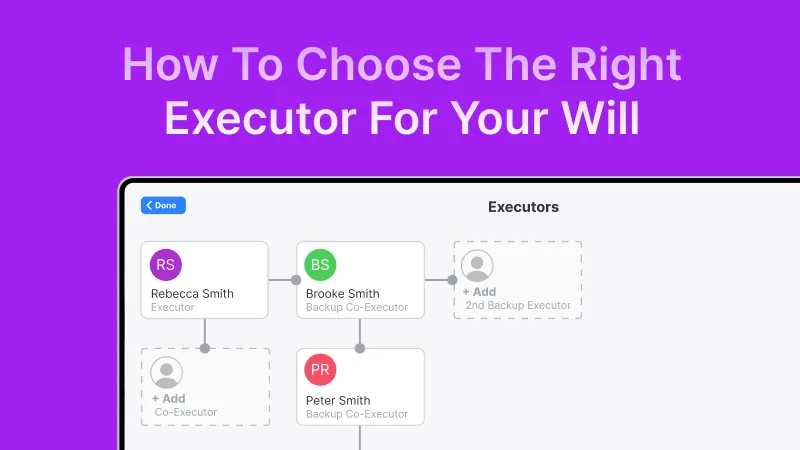
- Clear executors — Naming a capable executor (and backup executors) in the Will means the court knows who is entitled to apply. It avoids disputes about who should act and reduces the risk of delay or the need for someone to seek court appointment. See how to choose the right executor for your Will.
- Up-to-date asset list — A current list of assets (even if kept separately from the Will) helps the executor locate accounts and property quickly, complete the application accurately, and avoid missing assets or triggering requisitions.
- Correct execution — A Will that is properly signed and witnessed under your state’s law is less likely to be challenged or rejected. That supports a straightforward probate application.
- Digital access to documents — Storing a copy of the Will and key details in a safe place (and telling your executor where to find them) helps them lodge the application without delay. See where to store your Will for practical options; some people use a digital vault or give a copy to their executor or lawyer.
For state-specific signing and witnessing rules, see our guides: How to make a will in NSW, Victoria, Queensland, Western Australia, South Australia, Tasmania, ACT, and Northern Territory.
None of this is a substitute for legal advice in complex cases, but it reflects how careful Will-making and organisation can support a smoother probate process.
Frequently Asked Questions

John Ryan
Co-Founder & Estate Planning Advocate at Will Hero
About Will Hero
Will Hero is an Australian online Will platform that provides state-specific Will templates designed around Australian succession law. Documents are created using guided software and reviewed against jurisdiction requirements used across the platform. Thousands of Australians have used Will Hero to prepare their Will online.
Will Hero provides general legal information and document preparation tools and is not a law firm or a provider of personalised legal advice. The platform is intended for use by Australian residents making a Will under Australian state law.
Related Articles



Ready to create your Will? Start here · By state