- Estate Planning
Where Is The Safest Place To Store Your Will
Learn the safest ways to store your Will in Australia — from fireproof safes to legal professionals and digital backups.
Learn the safest ways to store your Will in Australia — from fireproof safes to legal professionals and digital backups. Discover what to avoid and how to ensure your Will is legally valid and easy to find.
First Things First: Your Will Must Be Legally Valid
Before we get into storage options, it’s essential to understand that in Australia, your Will must be printed, signed on paper, and witnessed properly to be legally valid. While services like Will Hero let you create and download your Will online, it’s the signed physical document that courts will accept.
In rare cases, a court may accept an ‘informal Will’ that doesn’t meet the usual signing rules, but this requires a legal application and is not guaranteed.
Want to learn how to make your Will legally binding? Read our step-by-step guide:
How to Make Your Will Legally Valid in Australia
Once that’s done, the original signed paper document becomes your official Will — and it needs to be stored somewhere safe, secure, and accessible.
Where Should I Store the Original Copy of My Will?
Let’s look at the four most common places Australians store their Wills, along with the pros and cons of each.

1. At Home (in a fireproof safe)
Storing your Will at home in a fireproof safe is the most common option chosen by Australians.
Pros:
- Convenient and free
- Immediate access when you need it
Cons:
- Risk of being lost, damaged, or destroyed (fire, flood, theft)
- Easy to misplace or forget over time
- People may not know where to find it
Best Practice If you choose to store your Will at home, use a fireproof, waterproof safe and make sure your executor knows how to access it. Don’t hide it too well!

2. With Your Executor
Some people choose to give the original signed Will directly to their executor for safekeeping — especially if they trust that person and want to ensure quick access when the time comes.
Pros:
- The executor doesn’t need to search or wait for access
- Avoids issues with hidden safes, locked boxes, or third parties
Cons:
- Risk of accidental loss or misplacement if the executor moves or passes away
- If your executor is also a beneficiary, it may raise concerns around transparency (though legally valid)
Best Practice If you do leave your Will with your executor, make sure:
- They understand the responsibility
- They store it securely (e.g. fireproof safe, labelled folder)
- Another trusted person (like a backup executor) knows this arrangement in case anything changes
3. With Your Lawyer or Estate Planning Professional
Pros:
- Stored securely and professionally
- Some lawyers keep Wills free of charge for clients
Cons:
- If your lawyer retires or their firm closes, it can be hard to track down
- May be inconvenient if your executor doesn’t live nearby
Tip Always keep a record of the lawyer’s contact details and let your executor know where the original Will is stored.

4. With a Trustee Company or Bank (Safe Deposit Box)
Pros:
- Long term secure storage
- Trusted custodianship
Cons:
- May charge annual fees or retrieval fees
- Banks may require identification and proof of authority (such as a death certificate and evidence you are the executor) before they will release a Will
- Not always necessary unless your estate is large or complex
Should I Store a Secondary Copy of My Will?
Yes — storing a backup copy can help ensure your Will is located quickly, even if the original is temporarily lost, misplaced, or hard to retrieve. But remember: Only the original signed document is legally binding.
Here are smart ways to store a secondary copy:

Printed Copies or Scans
You may wish to give a photocopy or scanned version to:
- Your executor
- A trusted family member
- A safe deposit box (not locked away without access instructions!)
If you need a printed copy of your Will, you can request professional printing and delivery when you create your Will online.
Again, this won’t replace the signed original, but can help jog memories or speed up legal processes. If the original is lost, a court may consider a copy — but only if there is strong evidence the original was not intentionally revoked. This process can be costly and is not guaranteed.

Digital Backup (for reference Only)
While only the original signed paper copy of your Will is legally valid, it’s a good idea to keep a digital backup — a scanned PDF or photo — in case you or your executor need to refer to it later.
Common options include:
- Saving it to a secure folder on your computer or phone
- Backing it up in a cloud storage service (like Google Drive, Dropbox, or iCloud
- Emailing a copy to yourself (with a clear subject line like “Copy of My Will – Not Original”)
- Sending a copy to your executor or a trusted family member
- Will Hero customers: store a copy in the Digital Vault for secure access alongside your other important documents
Important: A digital copy is not a legal substitute for the signed original. A digital copy cannot be used in place of the original signed Will in probate. It simply helps ensure your Will can be found and followed when needed.

Will Registries
Some states and territories offer registries or storage options where you can record the location of your Will (not the contents). Examples include:
- NSW Trustee & Guardian – Will Safe (NSW)
- Public Trustee (Victoria) and equivalent bodies in other states
- Private will registries available across Australia
Check your state or territory’s public trustee or Supreme Court website for local will storage or registration options. These services make it easier for your Will to be located — especially if your executor doesn’t know where to start looking.
Important note: Registration does not validate your Will or substitute for the original signed document. It simply helps locate where the original is stored.
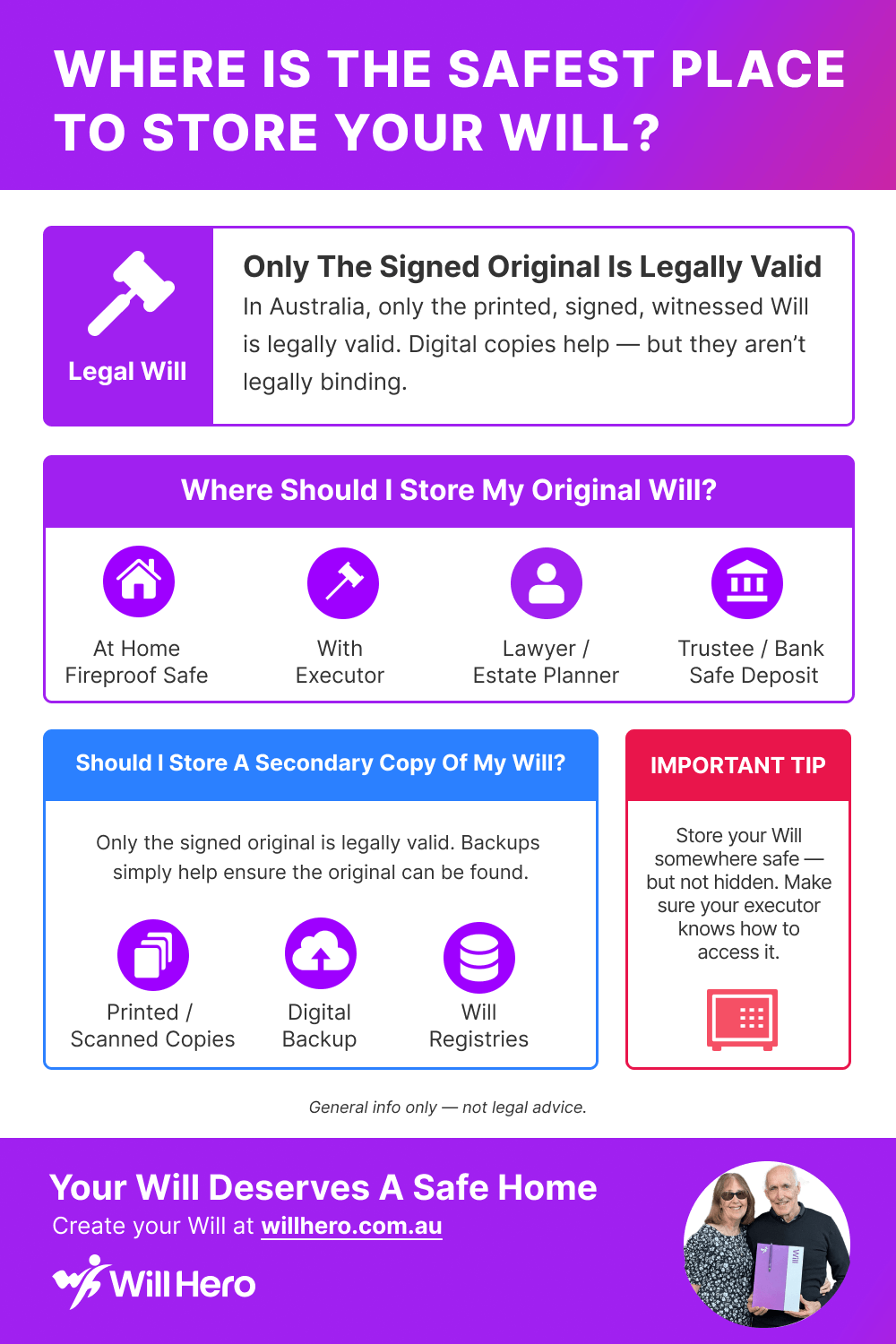
Where is the safest place to store your Will — quick reference infographic.
Summary: What We Recommend
At Will Hero, we recommend the following best practice:
- Make your Will legally valid - Print it, sign it, and follow your state’s witness rules.
- Store the original in a fireproof safe at home, or with your lawyer or trustee.
- Tell your executor exactly where it is and how to access it.
- Keep a digital backup (scanned copy) for reference — saved securely on your computer, in cloud storage, or emailed to yourself.
If you move interstate or own assets in multiple states: Check local Will laws as requirements may differ between states and territories. Some people choose to create separate Wills for assets in different states, though this is usually not necessary for most people.
Final Thoughts
Making a Will is a powerful act of care. But it only works if the right people can access the right document — at the right time.
With Will Hero, you can create and update your Will securely online, and ensure a backup is always available when you need it.
Your Will deserves a safe home — and your loved ones deserve peace of mind.
Frequently Asked Questions
No. In Australia, only the original signed and witnessed paper document is legally valid. Digital copies, scanned PDFs, or online versions cannot be used as your legal Will. However, you can and should keep digital backups for reference to help locate the original if needed. Courts may consider digital copies only as supporting evidence if the original is lost, but they cannot replace the legally signed paper Will.
Related Articles & Resources
You Might Also Like
Explore our comprehensive guides and resources to help you create a complete Will that protects your loved ones.
How to Make a Legally Valid Will in Australia
Complete step-by-step guide covering executors, beneficiaries, guardians, and all essential Will sections.
Read guide →What Happens If My Executor Dies Before Me?
Learn how backup executors work and why planning your executor chain is crucial for estate protection.
Read guide →How It Works
See how Will Hero’s visual interface makes it easy to create, update, and manage your Will securely online.
Learn more →Frequently Asked Questions

John Ryan
Co-Founder & Estate Planning Advocate at Will Hero
About Will Hero
Will Hero is an Australian online Will platform that provides state-specific Will templates designed around Australian succession law. Documents are created using guided software and reviewed against jurisdiction requirements used across the platform. Thousands of Australians have used Will Hero to prepare their Will online.
Will Hero provides general legal information and document preparation tools and is not a law firm or a provider of personalised legal advice. The platform is intended for use by Australian residents making a Will under Australian state law.
Related Articles


Ready to create your Will? Start here · By state